Frequently Asked Questions
Access
Are you a public library?
Lambeth Palace Library has welcomed readers and researchers since 1610, and everyone is welcome to visit and explore our collections.
We are a research library rather than a lending library, so some services commonly offered by public libraries are not available, such as book borrowing, children’s activities, public computer access, and printing facilities.
If you are looking for your local public library, you can find details on the Lambeth Council website.
How do I get to the Library?
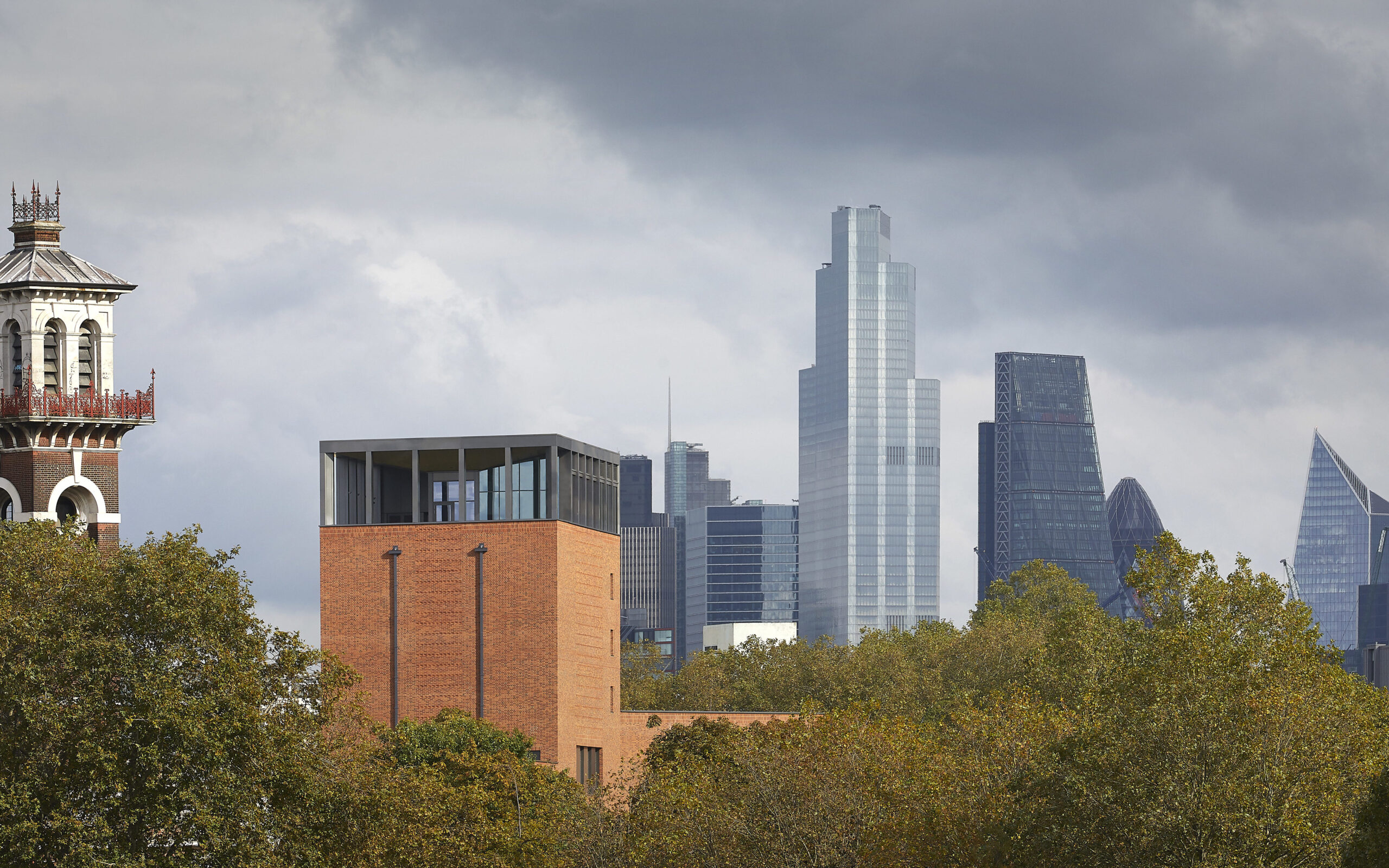
Lambeth Palace Library is located at:
15 Lambeth Palace Road
London SE1 7JT
We are opposite Evelina London Children’s Hospital. To enter the Library, pass through the two sets of automatic glass doors, where a member of our Security or Front of House team will be pleased to welcome you.
London Underground
The nearest Tube stations are:
- Lambeth North (Bakerloo line) – around 10 minutes’ walk
- Waterloo (Northern, Bakerloo, Waterloo & City lines) – around 10 minutes’ walk
- Westminster (Circle, District and Jubilee lines) – around 15 minutes’ walk
Bus
Several London bus routes stop nearby. The closest bus stop is St Thomas’ Hospital / Evelina London, served by the 77 and C10 routes. Additional services stop near St Thomas’ Hospital, Lambeth North, and Waterloo stations.
National Rail
The nearest railway stations are:
- Waterloo – around 10 minutes’ walk
- Vauxhall – around 15–20 minutes’ walk
- Victoria – around 25–30 minutes’ walk
River Services
The Library is also accessible by riverboat services. The nearest piers are:
- Westminster Pier (RB1, RB6) – around 15 minutes’ walk
- London Eye / Waterloo Pier (RB1, RB6) – around 10 minutes’ walk
Is there visitor parking on site?
We have a limited number of Blue Badge parking spaces available on-site. If you would like to use one of these spaces, please contact us in advance (ideally at least one day before your visit) so that we can make arrangements where possible.
Is the building wheelchair-accessible?
Yes — all public areas of the Library are wheelchair-accessible from street level, with lift access to our exhibition spaces and lecture rooms, including the Bancroft and Abbot Rooms. Desks in the Reading Room are designed to accommodate wheelchair users.
Accessible toilets for readers are available on the Ground Floor — including one close to the Reading Room — and on Floor 8 near the Bancroft Room.
If you have any questions about accessibility, our staff will be happy to help. You are also very welcome to contact us in advance of your visit to discuss any specific access requirements.
Can I just walk in?
Visiting the exhibition spaces
Yes — everyone is welcome to visit the Library during opening hours to explore our free exhibition spaces and browse our shop, which sells postcards, exhibition catalogues, and other merchandise.
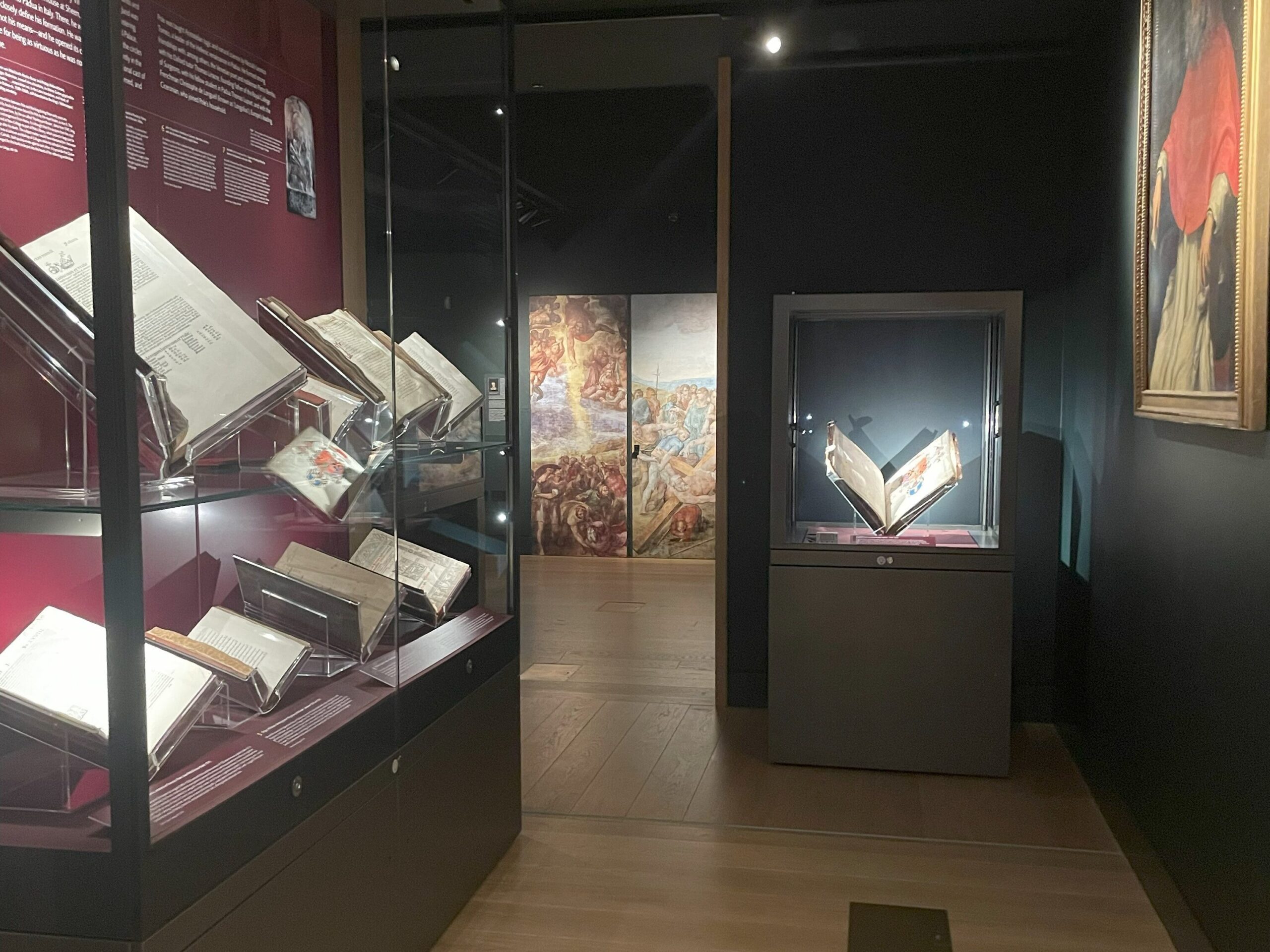
Our entrance hall includes permanent displays and interactive screens exploring the history of Lambeth Palace and the Library. We also host temporary exhibitions in our purpose-built gallery on Floor 1. Visit our Exhibitions page to see what’s currently on display. All exhibitions are free and do not require booking.
Using the Reading Room
If you would like to consult material from our collections in the Reading Room, we strongly recommend booking in advance. This allows our staff time to confirm your booking, retrieve requested items before your arrival, and help with any questions about the material you wish to see.
You are welcome to visit without a booking, but collection material is only fetched at the following times each day:
- 10:30
- 11:30
- 14:00
- 15:30
If you are simply looking for a quiet place to study, you are welcome to use the Reading Room. We do not take advance bookings for private study spaces, so please ask at Reception when you arrive. As space is limited, priority is given to readers consulting our (often unique) collections, and private study users may occasionally be asked to give up their seat if the Reading Room becomes full.
All Reading Room users — whether consulting our collections or using the space for study — must register as readers and follow the Library’s Reading Room guidelines. Further information can be found on our Registering and Booking page.
Attending talks and events
Most talks, tours, and special events require advance booking. Details of upcoming events can be found on our Events page, and you can sign up to our newsletter to hear about future programmes and activities.
What should I bring with me?
Please bring only the items you need for your research. To help protect our collections, bags (including laptop bags and pencil cases), coats, pens, food and drink, including sweets, chewing gum, water, and all other beverages or liquids, are not permitted in the Reading Room.
Lockers are available in the Readers’ Common Room for storing personal belongings, and we provide clear plastic bags so that you can carry essential items into the Reading Room. If you plan to use a laptop, tablet or other research materials, these can be taken into the Reading Room in the clear bag provided.
What ID do I need?
If you would like to use the Reading Room or consult material from our collections, you will need to register as a reader when you first visit. Please bring a form of photographic identification, such as a passport, driving licence, or other official photo ID.
If you are only visiting the exhibitions, attending an event, or browsing the shop, no identification is required.
For full details of reader registration requirements, please see our Registering and Booking page.
How long can I stay in the Reading Room?
You are welcome to stay in the Reading Room for as long as you wish during our opening hours. There is no time limit on visits, whether you are consulting our collections or carrying out independent research.
If you are using the Reading Room for private study rather than consulting Library material, you may use the space for the duration of your visit. However, as seating is limited, priority is given to readers using our collections. If the Reading Room becomes full and a reader needs a space to consult collection material, we may ask private study users to give up their seat.
Our current opening hours can be found on our Visit Us page.
Is there somewhere I can leave coats and bags?
Yes — visitors are welcome to leave larger coats and bags with our Security team at Reception.
To help protect our collections, bags (including laptop bags and pencil cases), coats, pens, food including sweets, drinks and other liquids including water are not permitted in the Reading Room. Lockers are available in the Readers’ Common Room for storing items not needed for research, and clear plastic bags are provided for carrying essential belongings into the Reading Room.
Please note that all items are left at the owner’s risk.
Are children allowed in the Library?
Children are very welcome in the Library’s public spaces, including our exhibition areas. Visitors under the age of 16 must be accompanied by an adult at all times. Access to the Reading Room is limited to readers aged 16 and over.
Do you have a café or tearoom?
We do not currently have a café or tearoom at the Library. However, visitors are welcome to bring their own food and drink and use the seating area on the mezzanine outside the Exhibition Room on Floor 1.
Readers may also use the Readers’ Common Room next to the Reading Room, which includes a fridge for storing lunches as well as complimentary tea- and coffee-making facilities.
To help protect our collections, food and drink — including water — are not permitted in the Reading Room or exhibition galleries.
Do you have baby-changing facilities?
Yes — baby-changing facilities are available in the Library. If you need any assistance during your visit, a member of staff will be happy to help.
Do you have a prayer room?
Yes. We have a small number of quiet rooms that can be made available for private prayer during your visit. Islamic prayer mats are also available on request.
If you would like to use a prayer space, please let us know in advance where possible (ideally at least one day before your visit) so that we can make the necessary arrangements. We will do our best to accommodate requests made at shorter notice.
Is there Wi-Fi?
Yes — visitors are welcome to use our guest Wi‑Fi network during their visit. Network details are available at Reception and throughout the Reading Room.
Do you have PCs that readers can use?
We have one PC available for readers consulting material on microfilm, as well as Reading Room terminals which provide access to our online catalogues.
For general internet use, we recommend that visitors bring their own device and connect to the Library’s free guest Wi Fi.
Is there a hearing induction loop?
Yes — a hearing induction loop is available in the Reading Room. Visitors using hearing aids should switch them to the T setting to connect to the system.
If you need any assistance during your visit, our staff will be happy to help.
Are there any group working spaces?
We do not currently have dedicated group working spaces. The Reading Room is intended for quiet study and research, and we ask all readers to help maintain a calm environment for everyone.
Readers are welcome to take phone calls and have conversations in the Readers’ Common Room. However, as this is primarily a shared quiet and break space, it is not suitable for group working sessions.
If you are interested in arranging a class or group visit, please complete our class enquiry form.
I can’t physically access the Library – can I access digital copies of material?
Yes — many items from our collections have been digitised and can be viewed online through our image database. You can browse the database.
If you have found material in our archives or printed books catalogues that is not available online, you may be able to order images through our Imaging Service. We can provide standard-quality images for private research, as well as high-resolution images suitable for publication.
Many of our recent exhibitions can also be explored online. Visit our Digital Exhibitions to browse them remotely.
Our image platform (LUNA) supports IIIF-compatible viewing and sharing.
Do you welcome Guide/Assistance Dogs?
Yes — Guide Dogs and other assistance dogs are welcome throughout the Library.
To help us care for our collections and ensure a comfortable environment for all visitors, other animals are not permitted in the building.
Collections
How can I find out what books/records you have?
Most of our collections can be searched online through our catalogues:
- Printed Books Catalogue — published books, pamphlets, and prints dating from the late fifteenth century onwards
- Archives and Manuscripts Catalogue — archival collections, manuscripts, and institutional records
Selected items from our collections have also been digitised and are available through our online image database, including many illuminated manuscripts, prints, and church plans.
Some collections are not yet fully catalogued. Information about these materials is available on our website.
If you are researching a particular subject or theme, you may also find our research guides helpful.
I can’t find what I’m looking for on the catalogue – can you help?
Yes — if you are having difficulty finding material in our catalogues, or would like to ask about collections that are not yet catalogued, please send us an enquiry.
We are happy to help with reference enquiries and guidance on using the collections. We aim to respond to all enquiries within 10 working days.
Can anyone access the collections?
Yes — anyone aged 16 or over is welcome to access the collections as a registered reader.
Information about registering for a reader’s pass and booking a visit can be found on our Registering and Booking page.
Please note that some collection items are too fragile, rare, or vulnerable to handling to be produced in the Reading Room. Where this is the case, we provide access through digital copies, microfilm, or other surrogates whenever available, allowing you to consult the material while helping to preserve the original item for future generations.
Do I need a letter of introduction to consult material?
No — you do not need a letter of introduction to consult material at Lambeth Palace Library. Anyone aged 16 or over is welcome to register as a reader and access the collections.
Can I take photographs of material in the Reading Room?
In most cases, yes. Readers are welcome to take photographs of collection material for private research and personal use at no charge. Please speak to a member of Reading Room staff to obtain a Self-Service Photography permit before photographing material.
Readers are responsible for ensuring that any photographs taken comply with copyright and other legal restrictions. Our staff will be happy to advise if you are unsure.
Further information about self-service photography can be found here.
Can I take specialist photographs of material using infrared, ultraviolet (UV) or other types of light source?
In some cases, yes. If you would like to photograph collection material using infrared, ultraviolet (UV), or another non-standard light source, please get in touch with us before your visit.
The lighting conditions in the Reading Room may affect the results you are hoping to achieve, but we’ll be happy to discuss your requirements and advise on what may be possible. We will always do our best to help, so it’s a good idea to contact us in advance to explore the options available.
Do you hold baptism/marriage/burial records?
Baptisms, marriages, and burials are normally recorded in parish registers. As Lambeth Palace Library primarily holds the records of the central bodies of the Church of England, we do not generally hold parish registers here.
In most cases, parish registers remained with the local parish church before later being transferred to a diocesan archive, county record office, or other local repository. If you need help identifying the most appropriate archive, please contact us and we will do our best to assist.
We do, however, hold records relating to marriages conducted by special licence. More information can be found in our research guide to marriage records held at Lambeth Palace Library.
You may find our family history research guide helpful for exploring the genealogical resources we hold.
My ancestor was a vicar – can you give me more information about them?
The Church of England did not historically keep centralised personnel files for its clergy, but it is often possible to trace a career through a range of other records and publications.
If you are beginning research into an Anglican priest, we recommend starting with our research guide to Anglican clergy, which explains the kinds of records we do — and do not — hold.
If you still cannot find the information you need, please send us an enquiry and we will be happy to advise. We hold a complete run of Crockford’s Clerical Directory and are happy to help with basic searches and advice.
Do you take donations of material?
We welcome offers of donations of printed books, archives, and other collection material where they support the Library’s collecting priorities and Collections Policy.
All potential donations are considered on a case-by-case basis. If you are considering making a donation, please contact us with further details and we will be happy to advise.
Are your records digitised?
Only a small proportion of our collections has currently been digitised, reflecting the size and breadth of the Library’s holdings. Digitised material includes most of our restricted items and many medieval manuscripts, as well as a significant number of prints and church plans.
Digitised items can be viewed through our online image database. You can browse the database here.
If you have found material in our archives or printed books catalogues that is not available online, you may be able to order images through our Imaging Service. We can provide standard-quality images for private research, as well as high-resolution images suitable for publication.
Many of our recent exhibitions can also be explored online. Visit our Digital Exhibitions here to browse them remotely.
Our image platform (LUNA) supports IIIF-compatible viewing and sharing.
Do you offer a research/translation/transcription service?
We regret that we are not able to undertake in-depth research on behalf of readers. To carry out detailed research, you will usually need to consult our collections in person, or engage an independent researcher.
We are unable to provide translation or full transcription services. We are happy to offer guidance on the collections and suggest relevant sources where possible.
Lambeth Palace Library cannot recommend specific researchers, but you can browse The National Archives’ directory of independent researchers.
Do you offer a photocopying service?
To help protect our collections, we do not photocopy material or provide printed copies.
Instead, you can order images through our Imaging Service. We can supply standard-quality digital copies for private research (as PDFs), as well as high-resolution images suitable for publication (JPG or TIFF formats).
Events and Exhibitions
Do I have to pay to get in?
No — entry to our exhibitions, and to most of our talks and events, is free of charge. Everyone is welcome to visit.
Some events may require booking or have a ticket charge, so we recommend checking the relevant event page for details. Donations are always appreciated and help support the Library’s work and public programme.
Visitors under the age of 16 must be accompanied by an adult at all times.
Do you conduct tours of the building?
Yes — we offer free public tours of the Library at selected times throughout the year. These are advertised via our newsletter and Eventbrite page and include an introduction to the history of the Library, a visit to the conservation studio, a view over the Reading Room, and access to our eighth-floor terrace with panoramic views of London.
Private tours may also be arranged on a case-by-case basis. If you are interested in organising a group visit or private tour, please contact us with further details.
Can I visit the exhibitions without booking?
Yes — you do not need to book to visit our exhibitions. They are free and open to all during our opening hours.
Some events associated with our exhibitions, such as lectures and curators’ talks, require advance booking. Please check the exhibition webpage or Eventbrite page for details.
How can I find out more about upcoming events?
The best way to stay up to date is to sign up to our email newsletter, where we share news of upcoming talks, tours, and events.
You can also browse all current listings on our Events page and our Eventbrite page.
Jobs and Work Experience
Do you have any vacancies?
All current job vacancies are advertised on our Vacancies page, where you can find details of current opportunities and how to apply.
Do you host volunteers/placement students?
We welcome volunteers and placement students aged 18 and over on a case-by-case basis, depending on availability.
If you are interested in volunteering or undertaking a placement, please email archives@churchofengland.org to register your interest.
We regret that we are not currently able to offer placements for those under 18.